
Primary 6 Mathematics
Our Primary 6 programme prepares students with comprehensive PSLE revision notes, rigorous practices and exam-simulated assessments to reinforce what they have learnt throughout Primary school.

Curriculum Overview
Topical Learning
For every new topic, we first cover the foundations and build conceptual understanding through:
Concept Paper
Focuses on the core conceptual components of each topic, supported by worked examples.
Problem Solving
Guided approach to solving multi-step problem sums.
Mind Stretcher Power Codes
Structured problem-solving strategies that help students identify question types and solve them efficiently and accurately.
Cranium Cracker (HA)
Stretch students' higher-order thinking skills through challenging questions such as Mind Twisters and Math Olympiad questions.
Hands-On Practice
Revision
We subsequently revise each topic, as well as mixed-topic questions, to ensure that students fully master the concepts through:
Cheat Sheet
Summary notes, and key tips and techniques to help students prepare for the PSLE.
Topical Revision
Reinforce key concepts and skills learnt in each topic.
Revision Papers
Recap and revise key concepts and heuristics learnt via practice questions.
Trending Questions
Commonly featured in recent school Prelim exams and the PSLE.
Assessments & Review
Students are exposed to PSLE-simulated questions under timed conditions, along with analysis of common mistakes through:
Checkpoints
Carefully curated questions to expose students to a range of problem sums with varying difficulty, helping them tackle the PSLE effectively.
Prelims
Students attempt a complete exam paper and sharpen test-taking skills under time-simulated conditions.
Error Analysis
Highlights common mistakes and misconceptions that students make such as conceptual errors or presentation issues (missing units).
Differentiated Programme for HA
Cranium Cracker (HA)
Stretch students' higher-order thinking skills through challenging questions such as Mind Twisters and Math Olympiad questions.
Our PSLE Mathematics Advantage
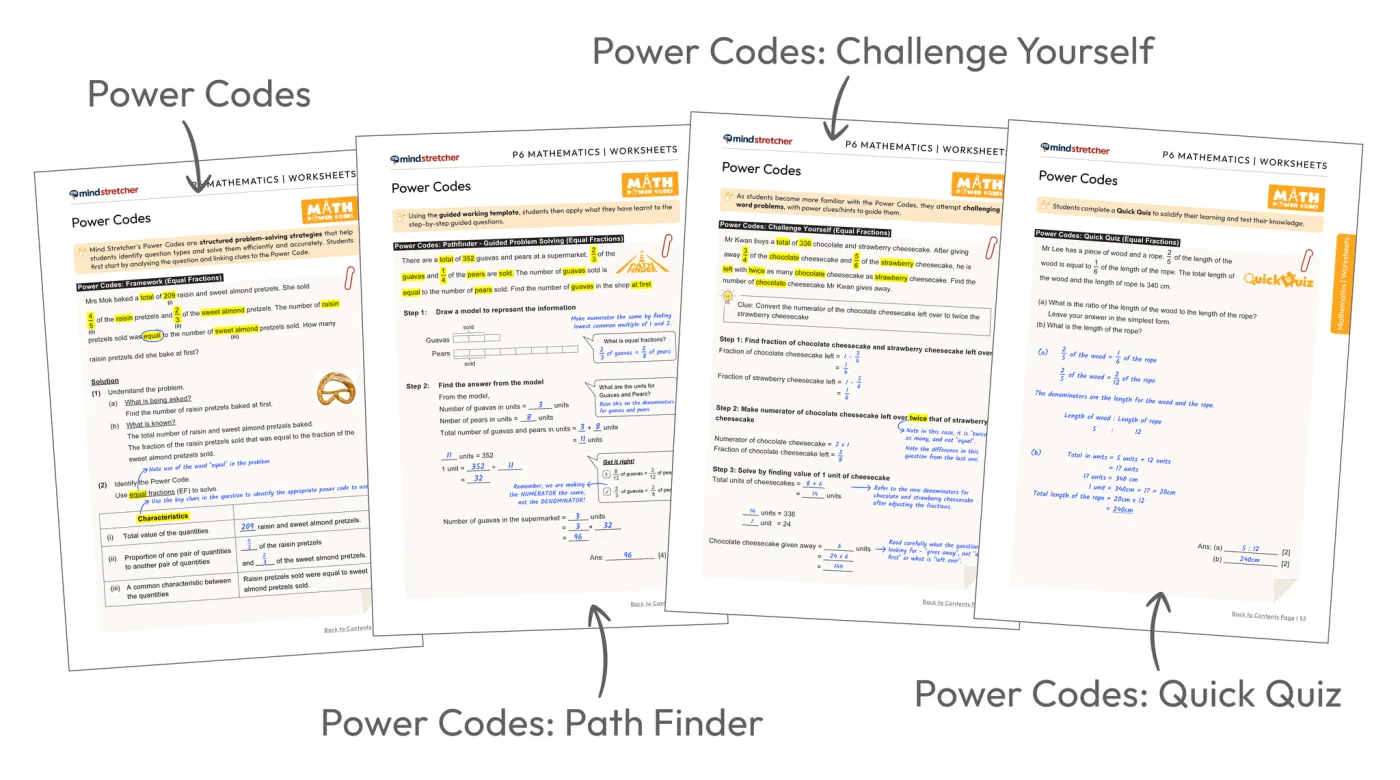
Power Codes
We know that problem sums are challenging for students. Our Mind Stretcher Power Codes are designed to help students identify question types easily and solve them efficiently and accurately, in a structured step-by-step approach.
Scaffolding
For problem sums, students first learn to identify question types and match them to the characteristics of the Power Code. Our working templates guide them through step-by-step solutions. Gradually, students tackle more challenging problems and test their understanding with our quick quizzes.
Topics
Fractions
- Dividing a proper fraction by a whole number
- Dividing a whole number/proper fraction by a proper fraction
- Solving word problems
Percentage
- Finding the whole given a part and the percentage
- Finding percentage increase/decrease
- Solving word problems
Ratio
- Relationship between fraction and ratio
- Solving word problems
Algebra
- Using a letter to represent an unknown number
- Notation, representations and interpretation of simple algebraic expressions
- Simplifying simple linear expressions
- Evaluating simple linear expressions by substitution
- Solving simple linear equations involving whole number coefficient
Area and Circumference of Circle
- Finding area and perimeter of circles, semicircles and quarter circles
- Finding area and perimeter of composite figures made up of square, rectangle, triangle, semicircle and quarter circle
Volume of Cube and Cuboid
- Use of square root and cube root
- Finding one dimension of a cuboid given its volume and the other dimensions
- Finding the length of one edge of a cube given its volume
- Finding the height of a cuboid given its volume and base area
- Finding the area of a face of a cuboid given its volume and one dimension
Special Quadrilaterals
- Finding unknown angles in composite geometric figures involving squares, rectangles, triangles, parallelograms, rhombuses and trapeziums
Resources
Homework Booster
Homework Booster
Supplementary worksheets with teacher-guided solutions are provided weekly on Mind Stretcher's E-Study Buddy platform for additional self-practice.
Progress Tracking
Assessment Checkpoints
Mind Stretcher's Assessment Checkpoints are conducted semestrally, to assess students' learning progress for timely intervention. In between, there will be regular revisions after every 2 or 3 topics to consolidate students' learning.
Student Progress Reports
Mind Stretcher's Progress Reports analyse strengths, weaknesses and benchmark students within our cohort, which is larger than a few schools combined!
Exam Preparation
Error Analysis
Analyse common student mistakes and concept misunderstandings, and learn how to avoid them.
Trending Questions
Stay abreast of questions set in examinations; we monitor and analyse trending question types and incorporate them into our revision materials.
Revision Notes
Comprehensive revision materials that summarise and reinforce important content for exam preparation.